Sagging Gutter or Hidden Roof Damage? Willmar, MN
Challenge
We were called out to look at the sagging gutters in Willmar, Minnesota.
The problem turned out to be much, much, worse.
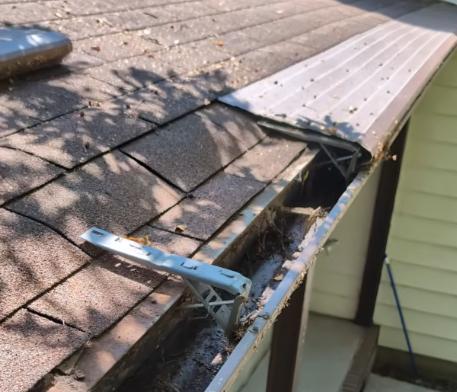
The homeowners’ gutters had a “helmet-like” system installed.
With a solid panel that slid up under the shingles.
The panel ran over about the first two rows of shingles and tucked in underneath the third. That means it wasn’t just sitting on the gutter. It had become part of the roof itself.
When we lifted the shingles to remove the solid plate of the old gutter system?
Underneath we found rotted fascia, lost entire row of starter shingles, and the whole gutter was not only sagging but pulling away from the house … about to fall off.
Why this happens
A normal roof is simple. Water runs down the shingles, over the edge, and into the gutter. Nothing is hidden.
When a rigid panel is wedged into the shingle layers, it adds a concealed seam right in the path of all that water.
When moisture gets under it, from rain, snowmelt, ice, or condensation, it can be slow to dry. Any debris that gets in holds moisture against the wood, which stays wet for days, weeks, or months in some parts of the year.
Of course wood that stays wet breaks down. Over time, the decking softens, loses strength, and rots. Once that happens, the roof edge stops directing water into the gutter, and water starts getting into the overhang.
What we can and can’t say
We want to be straight about this. Photos and a visual inspection can’t tell us exactly where the moisture came from.
It could have been rain getting in, ice and snow conditions, condensation, debris holding water, flashing problems, how the system was installed, or a mix of these.
What we can say is that the most severe damage was directly under and next to the concealed cover, and that nobody could have seen it from outside.
Which is why it gets missed.
And that’s what concerns us most. By the time there are visible signs, like stains, a leaking soffit, rotting fascia, or sagging, the damage underneath may already be extensive.
In this case?
By the time we got to it, this was no longer a gutter issue. It was a roof and structural repair.
Questions worth asking about any roof-integrated gutter protection
This case is a good reason to ask these before installing, or when evaluating something already on your home:
-
Does it change the path water takes off the roof?
-
Does it create hidden pockets where moisture or debris can collect?
-
Can the roof edge dry out properly?
-
How does it interact with the underlayment, drip edge, and shingles?
-
Can you inspect the roof edge without removing the system?
These matter even more in Minnesota, where roof edges deal with rain, heavy snow, freeze/thaw cycles, ice, and big seasonal temperature swings.
Solution
Here’s how this home should be fixed:
-
Remove the old helmet-style system and fully expose the roof edge.
-
Replace the rotted fascia and the missing starter shingles, and evaluate the underlayment and decking for damage.
-
Inspect the soffit cavity, rafter tails, and nearby framing for hidden moisture.
-
Restore the roof edge to a sound, properly flashed, water-shedding condition.
-
Install the Gutter Shutter system on the repaired fascia.
The takeaway: why Gutter Shutter is different
A gutter system should be judged on more than whether it keeps debris out of the gutter. It also matters what it does to the roof underneath.
That’s the key difference between a helmet-style system and Gutter Shutter. Helmet-style systems slide a panel up under your shingles. Gutter Shutter installs directly to the fascia board, completely independent of the roof. Nothing goes under your shingles, so there’s no concealed seam to trap moisture and no hidden pocket for debris to sit against your roof edge.
Here’s how Gutter Shutter answers the five questions above:
-
Does it change the path water takes off the roof? No. Water runs down your shingles and into the gutter, the way your roof was designed.
-
Does it create hidden pockets for moisture or debris? No. The fully enclosed, perforated design keeps leaves and pine needles out, and nothing is tucked under the roofing.
-
Can the roof edge dry out? Yes. Your shingles stay exposed.
-
How does it interact with the underlayment, drip edge, and shingles? It doesn’t. The exclusive high-back design keeps water from getting behind the gutter, which protects your roof and helps preserve your shingle warranty.
-
Can you inspect the roof edge? Yes. Your roofing isn’t hidden under a panel.
The sagging and pulling away we found in Willmar is also something Gutter Shutter is built to prevent. The system uses .032 premium-grade aluminum that won’t flex under heavy loads, with GutterStud brackets every 24 inches secured with 3-inch screws, backed by a no-pull guarantee. And it’s covered by a lifetime no-clog guarantee.
Would Gutter Shutter have prevented this? We can’t say for certain what caused every part of this damage, and we’ve been upfront about that. But the main suspect was a panel hidden under the roofing, and Gutter Shutter doesn’t have one. There’s no concealed seam, no moisture trapped under the shingles, and no helmet to pull a gutter off the house.
If you have a helmet-style system on your home and aren’t sure what’s under it, or your gutters are sagging, call Gutter Shutter of St. Cloud at 320-428-9621, or use the estimate form on our website, for a free, no-cost, no-pressure consultation.
We’ll take a look before the damage gets worse.